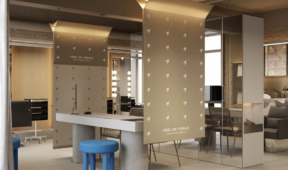
Facial cleansing is a professional cosmetic procedure for deep cleansing of the skin from sebum, comedones, and dead skin cells. It helps reduce blackheads, improve skin texture, refresh the complexion, and make daily care more effective.
Depending on the condition of the skin, its sensitivity, and the severity of the contamination, the beautician may recommend mechanical, ultrasonic, or combined cleaning.
Even with regular home care, the skin is not always cleansed as deeply as it should be. Excess sebum, makeup residue, dust, and dead skin cells gradually accumulate in the pores, which can make the face look dull, uneven, and less fresh. That is why this procedure is becoming an important part of systemic care for many, and not just an on-demand procedure.
In short: what is important to know about facial cleansing
Facial cleansing is one of the basic skin care procedures, but before booking, it’s important to understand a few key points:
- Facial cleansing is a deeper cleansing than regular home care.
- The procedure is suitable not only for rashes or blackheads, but also for dull complexion, oily sheen, or uneven skin tone.
- The main types of cleaning are mechanical, ultrasonic, and combined.
- The method is selected individually depending on the skin type.
- The effect is noticeable after the first procedure.
- It is important to follow the recommendations after cleaning.
What is facial cleansing and why is it needed?
Facial cleansing is a basic cosmetic procedure performed to deeply cleanse pores, remove accumulated dirt, sebum, dead cells, and comedones. It is selected individually, taking into account the skin type, its condition, and specific tasks.
Professional facial cleansing helps:
- cleanse pores more deeply than during regular home care;
- reduce the number of blackheads and comedones;
- remove excess sebum and dead cells;
- make the skin relief more even;
- refresh the complexion;
- prepare the skin for further care.
Home cleansing is important every day, but it doesn’t always allow you to effectively remove dense impurities in pores, closed comedones, or excess dead skin cells. That’s why professional facial cleansing does not replace home care, but complements it.
This procedure may be especially relevant for oily, combination or problematic skin, as well as in cases where the face looks uneven, dull or quickly loses freshness.If you choose a comprehensive [professional facial treatment], cleansing often becomes one of the basic steps of such care.
Basic types of facial cleansing
In modern cosmetology, various types of facial cleansing are used, but if we talk about your services, the main ones are mechanical, ultrasonic and combined cleansing. Each of them has its own characteristics, indications and advantages, so the answer to the question of which facial cleansing is best always depends on the individual condition of the skin.
Mechanical facial cleansing
Mechanical facial cleansing is a manual method of deep pore cleansing, during which the beautician removes comedones, blackheads, and other impurities using special tools. This format is often chosen when you need to thoroughly cleanse problem areas and get a more pronounced result.
Who is suitable for mechanical cleaning:
- for owners of oily and combination skin;
- with a large number of black spots;
- with heavily contaminated pores;
- with closed comedones;
- when deeper cleaning of problem areas is required.
Features of the procedure:
- allows for spot processing of individual areas;
- provides deeper pore cleansing compared to delicate hardware methods;
- may be less comfortable than ultrasonic cleaning;
- sometimes requires a short recovery period.
Advantages of mechanical cleaning:
- well suited for dense comedones and blackheads;
- gives noticeable results in problem areas;
- allows the beautician to work pointwise;
- helps make the skin cleaner, smoother and more well-groomed.
That is why mechanical facial cleansing should be performed by a specialist who will correctly assess the condition of the skin, choose a delicate approach, and tell you how to care for your face after the procedure.

Ultrasonic facial cleansing
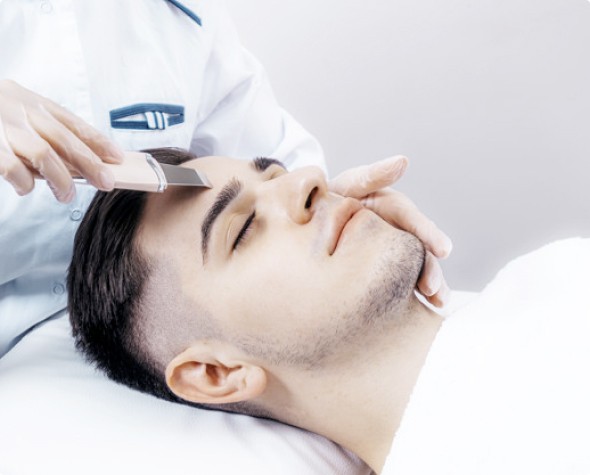
Ultrasonic facial cleansing is a delicate hardware procedure during which the skin is cleansed using ultrasonic waves. This method helps remove surface impurities, dead skin cells, and makes the skin smoother and fresher.
Who is suitable for ultrasonic cleaning:
- for owners of normal, dry or sensitive skin;
- with minor pore contamination;
- with a dull complexion;
- when you need to gently refresh your skin;
- if a delicate cleaning format without active mechanical action is important.
Features of the procedure:
- is performed using an ultrasound device;
- works more gently than mechanical cleaning;
- more suitable for surface cleaning;
- usually has a minimal recovery period;
- not always sufficient for dense comedones or a large number of blackheads.
Advantages of ultrasonic cleaning:
- gently cleanses the skin;
- helps to even out tone and texture;
- refreshes the face;
- suitable for more sensitive skin;
- more comfortable compared to mechanical cleaning.
If we compare ultrasonic and mechanical facial cleansing, the former is usually more comfortable, while the latter is deeper in its effect. That is why you should choose the method not based on popularity, but on the condition of your skin and the recommendation of a beautician.
Combined facial cleansing
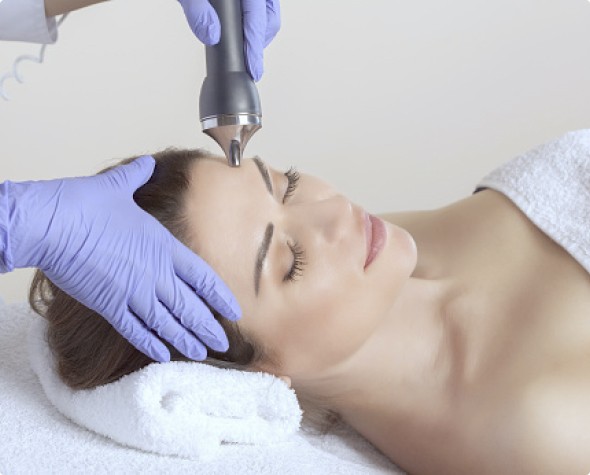
Combined facial cleansing combines mechanical and ultrasonic techniques. That is why it is often considered one of the most versatile formats when the skin has different needs in different areas.
This approach allows you to simultaneously work more intensively where needed, and more delicately in sensitive areas.
Who is combined cleaning suitable for:
- for owners of combination skin;
- with uneven facial condition;
- when there are both black spots and sensitive areas;
- with simultaneous presence of dirt and areas requiring delicate care;
- if you need a balance between deep and gentle cleansing.
Features of the procedure:
- combines two cleaning methods in one procedure;
- allows you to work individually with different areas of the face;
- The T-zone is usually treated more deeply, while other areas are treated more delicately;
- The procedure format is selected according to the skin condition.
Advantages of combined cleaning:
- universal approach to different skin types;
- combining the efficiency of mechanical cleaning and the comfort of ultrasonic cleaning;
- a more balanced result;
- the ability to solve several tasks simultaneously.
That is why combined facial cleansing is often the optimal solution when the skin has different needs and requires an individual approach to each area.
Comparison of facial cleansing types
| Criterion | Mechanical | Ultrasonic | Combined |
| Cleaning type | Deep | Superficial | Superficial |
| For which skin | Oily, combination | Normal, dry, sensitive | Combined |
| Working with black dots | ✔️ Most effective | ⚠️ Limited | ✔️ Good |
| Comfort procedures | Average | High | Average |
| Recovery period | Maybe | Minimum | Moderate |
| Main effect | Deep pore cleansing | Refreshing, leveling | Balance cleaning |
| When to choose | With pronounced comedones | For light soiling | For different skin needs |
In short: mechanical cleaning gives the deepest result, ultrasonic cleaning is the most delicate, and combined cleaning is a universal option for most cases.
Which facial cleanser is right for you?
To understand which facial cleansing is best for you, it is important to consider your skin type, its sensitivity, the number of comedones, and the severity of blackheads. The same method will not be equally effective for everyone, so the choice is always individual.
As a rough guide, you can start from the following criteria:
- Mechanical facial cleansing— suitable for a large number of blackheads, densely clogged pores and pronounced comedones. Provides deeper cleansing.
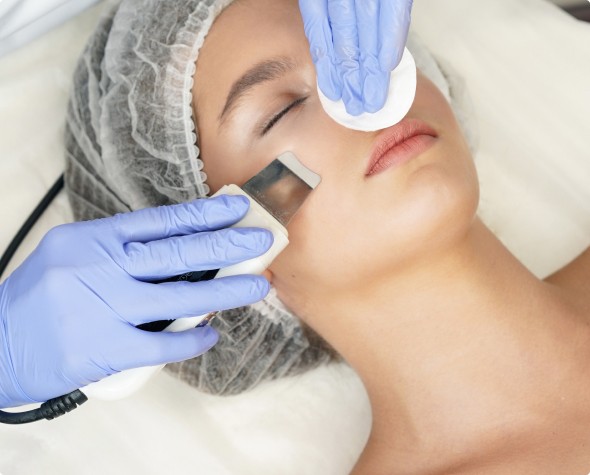
- Ultrasonic facial cleansing— suitable for sensitive skin or with minor contamination when a more delicate effect is required.
- Combined facial cleansing— the best option for combination skin, when different areas require different approaches.
The choice of procedure does not depend on trends or the popularity of a particular method, but on the actual condition of the skin. That is why consulting a cosmetologist before the procedure helps to choose the option that will be right for you.
At PIED-DE-POULE, the format of the procedure is selected individually so that cleansing is not just a popular service, but a solution that truly corresponds to the skin condition. If necessary, this stage can be combined with a consultation with a beautician or other procedures that complement the care.
Indications for facial cleansing
Facial cleansing is recommended when the skin needs a deeper cleansing and standard home care is no longer enough. The procedure is most often used in cases where blackheads appear, pores become more noticeable, the skin quickly becomes oily or loses its fresh appearance.
The main indications for facial cleansing:
- blackheads and comedones;
- enlarged pores;
- oily sheen;
- uneven skin texture;
- dull complexion;
- isolated rashes;
- the desire to improve the overall appearance of the skin and make care more effective.
Facial cleansing is also often chosen as part of regular care, when it is important to maintain the skin in a cleaner, smoother, and more well-groomed condition.
How to understand that you need facial cleansing
The need for facial cleansing is usually not apparent from one symptom, but from several signs at once. You should pay attention to the procedure if you notice:
- the skin becomes oily more quickly during the day;
- pores have become more noticeable;
- blackheads or closed comedones appeared;
- the skin relief has become uneven;
- the face looks dull and less fresh;
- cosmetics do not apply as evenly as before;
- Home care does not give a feeling of cleanliness and freshness.
If your skin looks congested, loses its smoothness and well-groomed appearance, this may be a signal that it needs a deeper professional cleansing.

What effect does facial cleansing have?
The effect of facial cleansing depends on the initial condition of the skin, the correctly selected technique and compliance with the recommendations after the procedure. In most cases, changes are noticeable after the first session, but for a stable result, systematic care is important.
Effect immediately after the procedure
After cleansing your face, you can usually notice the following changes:
- the skin looks cleaner and fresher;
- pores become less noticeable;
- oily shine is reduced;
- the skin relief looks more even;
- complexion improves;
- a feeling of smoothness and well-groomedness appears.
Depending on the type of cleaning and your individual skin reaction, there may be slight sensitivity or redness after the procedure, especially if it involves mechanical cleaning. This is usually a temporary reaction that gradually resolves with proper care.
Effect with regular care
If facial cleansing is done regularly and combined with home care, the result becomes more stable. In this case, the procedure helps:
- reduce the accumulation of impurities in the pores;
- keep the skin cleaner and more well-groomed;
- gradually reduce the number of blackheads;
- improve the perception of home care products;
- keep your face looking fresh longer.
In many cases, after such a cleansing, it is advisable to supplement the routine with other [skin care procedures], if they are recommended by a specialist.
What not to expect from facial cleansing
It is important to understand that facial cleansing does not replace full-fledged home care and does not always eliminate the cause of rashes if it is associated with internal or complex factors. It is a procedure to cleanse, improve the appearance of the skin and maintain its well-groomed condition.
Properly selected cleansing can significantly improve the overall condition of the skin, but it gives the best results as part of systematic care.
How the facial cleansing procedure works
The exact protocol may vary depending on the type of cleansing and skin condition, but the procedure usually consists of a few basic steps.
- Skin cleansing and makeup removal
First, the beautician cleanses the skin of makeup, sebum, and surface impurities to prepare it for the procedure. - Skin condition assessment
Before choosing a specific technique, the specialist assesses the skin type, its sensitivity, the severity of impurities, and areas that require more delicate or intensive cleansing. - Preparation for the main stage
The skin is prepared for cleansing using professional products that help make the procedure more comfortable and effective. - The main cleaning stage
Next, mechanical, ultrasonic, or combined cleaning is performed, depending on the chosen method and the skin’s needs. - Soothing care
After the main stage, soothing and caring products are applied to the skin to help reduce sensitivity and maintain comfort. - Final recommendations
The cosmetologist explains how to care for the skin after the procedure, which products or activities are best avoided temporarily, and when you can repeat the cleansing.
On average, a facial cleansing lasts from 60 to 90 minutes. The duration depends on the format of the procedure, the number of areas to be treated, and the severity of the impurities.
What to do after cleansing your face
Post-cleansing care directly affects how quickly the skin will recover and how comfortable the post-procedure period will be. That is why it is important to follow the recommendations of a specialist and not overload the skin with active products immediately after cleansing.
After cleansing the face, it is usually recommended to:
- do not touch your face with your hands unnecessarily;
- do not use scrubs and aggressive products;
- avoid saunas, swimming pools and active sun;
- use moisturizers;
- Be sure to apply SPF before going outside;
- If possible, do not apply heavy makeup immediately after the procedure.
In the first few days after a cleanse, your skin may be more sensitive, so it’s important to avoid anything that could further irritate it. Gentle cleansing, moisturizing, and sun protection help your skin recover faster and maintain the results of the procedure.
How often to cleanse your face
The frequency of facial cleansing depends on the type of skin, its condition, the number of comedones, sensitivity, and the characteristics of home care. There is no universal schedule for everyone, so it is better to choose the optimal regularity together with a beautician.
For oily skin
Oily skin usually needs to be cleansed more often, as sebum accumulates more actively in the pores and can provoke blackheads and comedones. The approximate frequency is once every 1–2 months.
For combination skin
Combination skin may require different approaches in different areas: the T-zone tends to get dirty faster, and the cheeks can be more sensitive. As a rule of thumb, cleansing can be done every 1.5–2 months, depending on the condition of the skin.
For normal skin
If the skin does not have significant dirt, blackheads, or oily sheen, cleansing can be done less frequently — about once every 2–3 months. In this case, the procedure works more as a maintenance treatment.
For dry or sensitive skin
Dry and sensitive skin requires the most delicate approach. The frequency of cleansing is selected individually so as not to overload the skin and provoke irritation.
If you are not sure how often you should cleanse your face, it is best to rely not on general recommendations, but on the advice of a beautician.
Contraindications to facial cleansing
Despite the popularity and benefits of the procedure, facial cleansing has contraindications. It is not performed or postponed if there are conditions that may complicate the procedure or the recovery period.
Facial cleansing is not recommended for:
- active inflammation on the skin;
- skin damage, scratches or open wounds;
- herpes in the acute stage;
- severe irritation or severe skin sensitivity;
- individual reactions to cosmetic products or procedures.
Before cleaning, it is important to undergo a consultation so that the specialist can assess the condition of the skin and determine whether the procedure is suitable at this time. If there are temporary contraindications, the beautician may advise you to postpone the appointment or choose a more delicate care format.
Conclusion
Facial cleansing is not just a cleansing step, but an important part of a systematic skin care regimen. It helps keep pores clear, improves the appearance of the skin, and makes subsequent care more effective.
The best results come from a procedure that is individually selected, taking into account your skin type, sensitivity, and specific needs. At the PIED-DE-POULE salon chain, the facial cleansing format is individually selected so that the result looks natural, delicate, and appropriate for you.