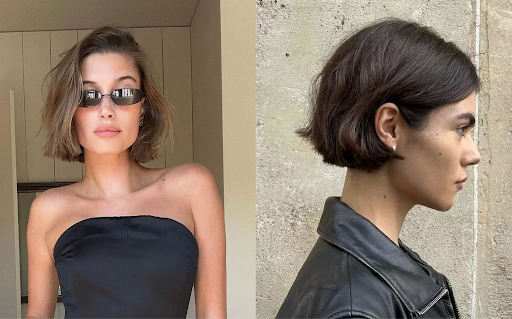
A short haircut changes more than just hair length. It exposes the neck, draws more attention to the cheekbones, jawline and eyebrows, and can sometimes completely reshape facial proportions. That’s why a haircut photo you liked on social media is a good reference point for your stylist, but not yet a finished decision.
The very same shape behaves differently on straight fine hair, dense curls, or porous strands that react to moisture. Even the direction of hair growth matters: a crown whorl can create natural volume in a pixie but work against a perfectly smooth short bob.
In 2026, short women’s haircuts are becoming less rigid. Instead of a heavy, static line, movement-friendly layers, soft texturising, elongated fringes and shapes that can be styled in several different ways are increasingly popular. But a haircut being trendy doesn’t mean it will automatically suit every woman. The final choice depends on hair density and texture, facial proportions, your usual at-home styling routine, and how often you’re willing to come in for a trim.
The key points in brief. In 2026, the pixie with elongated strands, the bob with natural movement, the French bob, the bixie and the short textured wolf cut are all on trend. Fine hair tends to suit a blunt cut or controlled short layers better, while thick and wavy hair benefits from texturising that removes excess weight. A haircut shape is worth choosing not by a single factor, but with your face, hair growth, hair condition and daily habits all taken into account. If you’d rather not spend time on complicated styling, that’s worth discussing with your stylist before the first cut.
Which women’s haircuts are trending right now
Short hair has remained a prominent direction for several seasons now. Vogue calls 2026 the third year in a row of strong interest in short shapes, though the haircuts themselves are gradually evolving: becoming softer, lighter and less demanding of flawlessly sleek styling. Among the current standouts, the magazine highlights the graduated bob, the bixie and the pixie — a shape that still looks good even as it grows out.
The main trend in women’s haircuts for 2026 isn’t a specific length, but adaptability. A bob can have a blunt cut or textured layers, a pixie can be sleek or tousled, and a French bob doesn’t have to be styled into a perfectly flat sheet. On the contrary, natural wave and a bit of easy imperfection often make the shape more interesting.
Among the most current short haircuts are:
- a pixie with an elongated fringe or movement-driven texture;
- a classic bob with a clean but not overworked cut;
- a bob with soft volume and face-framing layers;
- a short French bob to the chin;
- a garçon with an exposed nape;
- a bixie — an in-between shape between bob and pixie;
- a short wolf cut with choppy layers;
- women’s haircuts with a fringe: light, side-swept, choppy or blunt.
Fringes are also becoming more noticeable in 2026. Trends include both short, graphic versions and softer strands that fall onto the forehead and blend into the overall shape. However, the length is important to choose with hair growth in mind: a strong whorl near the hairline may call for daily styling.
Pixie and Bob: the most popular base shapes
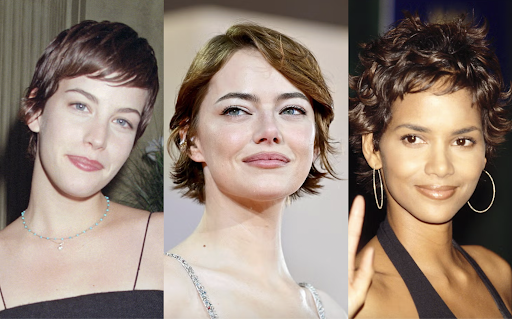
Pixie and bob are often called universal short haircuts, although there are far more differences between them than might seem obvious.
A pixie means a shorter nape and temples, while the crown and fringe area can stay longer. It’s this distribution of length that defines the character of the haircut. A sleek pixie with a short fringe looks graphic, while a version with longer layers looks softer and more mobile.
This kind of women’s haircut opens up the face, so the eyebrows, cheekbones, ear shape and neckline all become especially noticeable. That’s not a drawback — it’s a feature to work with. Through crown height, an asymmetric fringe, or elongated temple strands, the stylist can adjust visual proportions.
For fine hair, a pixie is often a convenient solution: short strands weigh down less and lift more easily at the roots. But excessive thinning can, on the contrary, make the hair look visually sparser. So it’s important not just to “add texture”, but to leave enough density in the right areas.
A bob has a longer cutting line. The hair usually ends somewhere between the earlobe and the base of the neck, though modern variations aren’t limited to one length. The front strands can be a little longer, the nape graduated, and the top layers light and mobile.
As Glamour writes, in 2026 there’s renewed interest in 1990s-style bobs: they have more texture on top and change direction easily during styling. Unlike a rigid, geometric bob, this shape isn’t meant to lie strand-for-strand perfectly flat.
A bob suits anyone who wants short length but isn’t ready to fully expose their ears and nape. It can be blown out with a round brush, styled to bring out a natural wave, turned into soft curls, or pinned back at the front with an accessory.
Which haircut suits whom
| Haircut | Who it suits | Hair type | Face shape | Styling complexity | Touch-up frequency | Effect |
| Pixie | Anyone ready to expose their face and keep up a short shape regularly | Straight, wavy, fine or medium-density | Oval, elongated; can adapt to round | Low to medium | 3-5 weeks | A striking silhouette, emphasis on facial features |
| Bob (classic) | Anyone who likes clean lines and classic shapes | Straight, slightly wavy | Oval, square, elongated — depending on length | Medium | 6-8 weeks | A neat, dense shape |
| Bob (layered) | Anyone who wants a versatile short haircut | Straight, wavy, medium-density | Round, oval, square | Low to medium | 6-8 weeks | Lightness, movement and volume |
| French bob | Anyone who likes short, chin-length hair and an exposed neck | Straight, softly wavy | Oval, elongated; length adjusted individually | Low to medium | 5-7 weeks | A neat silhouette with easy imperfection |
| Garçon | Anyone ready for an exposed nape and a compact shape | Straight, fine or medium-density | Oval; other shapes need adapting with a fringe | Low | 3-5 weeks | A sharp shape, emphasis on the neck and face |
| Bixie | Anyone torn between a short bob and a pixie | Medium-density, straight or wavy | Oval, round, elongated | Low to medium | 4-6 weeks | Texture and volume without an ultra-short length |
| Wolf cut | Anyone who likes pronounced layers and a less classic shape | Wavy, curly, thick; fine hair needs careful cutting | Oval, square, round — once volume is adapted | Medium | 6-8 weeks | Movable, choppy texture |
Other trending women’s haircuts
French bob, garçon and bixie
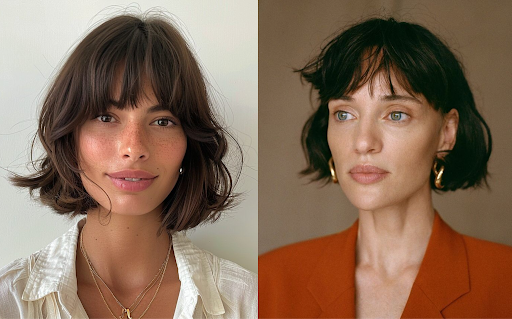
A French bob usually ends around the chin or just above it. It’s often paired with a fringe, though that isn’t essential. A blunt line makes the shape more graphic, while light graduation helps the hair move more naturally.
Contrary to popular belief, a French bob doesn’t need to be straightened every day. Byrdie recommends emphasising the natural texture for a modern version, or shaping waves in different directions and then gently breaking them up by hand. This makes the haircut look less staged.
A garçon is shorter and sits closer to the head. It differs from a pixie in having a more unified silhouette and smoother transitions between zones. In its classic version, the nape, temples and crown connect without sharply defined long layers.
This shape shows off the quality of the cut clearly. Once the hair grows out even by a centimetre, the contour around the ears and nape starts to shift, so a garçon needs regular touch-ups. Daily styling, on the other hand, often takes just a few minutes.
A bixie combines the shortness of a pixie with the longer layers of a bob. Vogue describes it as a haircut you can rake through with your fingers and tuck behind your ears: it has enough length for different styling options while staying light. In summer 2026, the magazine named the bixie one of the season’s leading short shapes.
A bixie works well both as a standalone haircut and as a transitional stage while growing out a pixie. But the shape’s apparent looseness only seems accidental. For the strands to fall nicely without lengthy styling, the stylist needs to determine the exact layer lengths precisely and take the direction of hair growth into account.
The Wolf Cut as an alternative to classic shapes
The wolf cut combines features of the shag and the mullet: shorter layers build volume in the upper section, while the lower strands stay longer and more movable. On short hair, this contrast can be subtle, without a sharp “tail” at the nape.
In 2026, the short wolf cut is seen as an alternative to the everyday bob. Vogue notes that it can be adapted for straight, fine, thick and curly hair by adjusting the intensity of the layers and the styling method.
This haircut behaves most naturally on wavy hair, which shapes the texture on its own. On very straight hair, it may need a salt spray, mousse, or a bit of work with a styling wand. Fine strands shouldn’t be over-thinned: instead of an airy shape, you risk weak-looking ends and a loss of density.
How to choose a haircut by face shape
Choosing a haircut by face shape isn’t about finding a way to “fix” your appearance. The stylist’s task is to place volume, length and the cutting line correctly, according to the effect you want.
Besides the width of the forehead, cheekbones and jaw, the profile, forehead height, neck length, ear position and usual parting are all taken into account. That’s why two women with a formally identical face shape can still suit different haircuts.
Round and square faces
For a round face, shapes that create a vertical direction are often chosen: a pixie with volume at the crown, a bixie with an elongated fringe, or a bob where the front strands end below the widest part of the cheeks.
Short women’s haircuts for a round face don’t necessarily need to hide the sides. Balance matters more. For example, dense volume right at cheek level can emphasise width, while height on top and a diagonal fringe shift the direction of the eye.
For a square face, there are two possible approaches. The first is to soften the pronounced jawline with a wave, layers or a fringe. The second is the opposite — to support the geometry with a sharp bob. The choice depends on whether you want a softer look or want to emphasise your distinctive features. Suitable options include:
- a bob with longer face-framing strands;
- a textured bixie;
- a short wolf cut with a movable top layer;
- an asymmetric pixie;
- a bob with length below or above the jawline, but not exactly at it.
Oval and elongated faces
An oval face allows you to experiment with most short shapes, but that doesn’t mean any length will be equally comfortable. The choice still depends on hair structure, profile, and the degree of openness you want.
Short haircuts for an oval face can be either graphic or textured: a garçon, a pixie, a French bob, or a short bob. If you want to draw attention to the eyes, you can add a fringe. To open up the cheekbones, leave a clean line near the face.
For an elongated face, you usually don’t need extra height at the crown. Horizontal lines, a fringe, volume at the temples and chin-length bobs tend to work better. Very short temples combined with a high top can visually emphasise verticality, though this can easily be corrected with fringe length.
Roughly, the shapes can be grouped as follows:
- round face: an elongated face-framing bob, an asymmetric pixie, a bixie with volume on top;
- square: a textured bob, a wavy bob, a wolf cut, a soft fringe;
- oval: a pixie, a garçon, a French bob, a bob and most bob variations;
- elongated: a French bob, a chin-length bob, a haircut with a fringe and volume on the sides.
How the haircut selection and process work
Consultation and choosing the length
Before the haircut, the stylist clarifies more than just the length you want. It’s important to understand how your hair behaves after washing, whether you use a hairdryer, whether you have a habit of straightening or curling your strands, and how much time you can spend styling in the morning.
During the consultation, the following are assessed:
- hair density in different zones;
- strand thickness and porosity;
- natural wave or curl;
- growth direction and any whorls;
- head shape and facial proportions;
- the condition of the ends after colouring;
- your preferred touch-up frequency;
- whether the hair can be tied up or pinned.
Reference photos help explain the mood you want, but the stylist adapts the shape to your specific hair. For example, a pixie with a dense, voluminous crown on fine hair may need a different length and fewer layers than in the photo.
Stages of the haircut and final styling
Once the shape is agreed, the stylist divides the hair into sections and creates the main length. Next comes the contour, weight distribution and, if needed, added layers. Texturising is done last, once it’s clear where the hair needs lightness and where density should be kept.
Curly hair may be checked again once dry, since different strands shrink unevenly after drying. This is especially important for short curls: a difference of even a few millimetres affects the silhouette.
Final styling after the haircut isn’t only for a beautiful result. It shows how the shape works, where the natural volume appears, and how to repeat the main movements at home. At PIED-DE-POULE, the stylist can also recommend products suited to your hair’s texture, rather than simply based on the type of styling you want.
Who might want to think twice before choosing a short haircut
There are no absolute restrictions on short hair, but sometimes a length change doesn’t fit a client’s lifestyle or expectations.
It’s worth postponing a radical haircut if your hair is actively shedding and the cause hasn’t been identified yet, if your scalp is irritated, or if you have a period ahead when you won’t be able to get regular touch-ups. It’s also worth thinking about whether you’ll feel comfortable fully exposing your neck, ears and jawline. A short shape may prove impractical if you:
- tie your hair up daily for work or workouts;
- aren’t ready to visit the salon every four to eight weeks;
- want to give up styling entirely, even though your hair has strong whorls;
- often change your parting and the way you wear your hair;
- aren’t sure you’re ready for a noticeable change of look.
When a short length isn’t the right fit just yet, an elongated bob or a layered shape on medium-length hair can be a good alternative, leaving more room for up-dos.
How long the result lasts and how often touch-ups are needed
Hair grows on average about a centimetre a month, but on a short haircut even a smaller length change becomes noticeable. The contour around the ears loses its sharpness, the nape grows out, and the top strands start distributing volume differently.
Ultra-short women’s haircuts, garçons and sharp pixies are usually touched up every 3-5 weeks. A bixie can hold its shape for 4-6 weeks, while a bob, a classic bob or a wolf cut lasts roughly 6-8 weeks.
This isn’t a rigid schedule. A soft, textured haircut grows out less noticeably than a geometric one. But if keeping an open nape, a clean line by the ears, or a specific fringe length matters to you, a touch-up will be needed sooner.
How much does a haircut cost
The cost of a women’s haircut doesn’t depend only on the starting length. Short shapes can require very precise work with the contour, transitions and weight distribution. This is especially true for a pixie, a garçon and a geometric bob, where any error is instantly visible. It’s best to check the current price in the price list of the specific PIED-DE-POULE salon or during online booking.
What affects the price
- the stylist’s category and experience;
- the starting length and density of your hair;
- the complexity of the chosen shape;
- the need to change a previous haircut;
- washing, care, and final styling;
- extra texturising for curly or very thick hair;
- the need to correct an uneven contour;
- the pricing policy of the specific salon within the network.
Before starting the procedure, our experts always clarify exactly what’s included in the service. This helps you understand not only the price in advance, but also the expected result.
Caring for a short haircut
Short hair dries faster and needs less product, but that doesn’t always mean no care is required at all. On a compact shape, dry ends, loss of shine, excess styling product and an overgrown contour are all more visible.
Shampoo and conditioner should be chosen based on the condition of the scalp and hair, not the length. After lightening or regular heat styling, short strands need just as much hydration and heat protection.
Styling at home
For most short shapes, a hairdryer, a comb or a small round brush and a single styling product are enough.
Home styling might look like this:
- blot the hair with a towel without rubbing it;
- apply heat protection and a small amount of mousse or cream;
- dry the roots first, setting the direction you want;
- style the fringe first, before it starts drying on its own;
- for a sleek bob, direct the airflow from top to bottom;
- for a pixie or bixie, lift the strands with your fingers or a brush;
- dry curly hair with a diffuser at a moderate temperature;
- apply paste, wax or texturising spray in small amounts;
- finish the style with a light product, without overloading the roots.
Fine hair usually suits light mousses, sprays and root-volumising powders better. Heavy creams and oils can make it look flat. Thick or porous hair, on the other hand, sometimes needs a cream that tames excess puffiness.
How to extend the fresh look of your haircut
To keep your haircut looking well-groomed for longer:
- stick to your recommended touch-up schedule;
- don’t trim your own fringe or the hair around your ears;
- use heat protection before a hairdryer or styling tool;
- don’t apply wax or paste directly to the roots;
- clean product buildup off your brushes and combs;
- dry your hair in the direction your stylist showed you;
- protect coloured hair from strong sun exposure;
- choose products based on density and porosity;
- don’t try to fix a loss of shape with a heavy amount of hairspray.
If a bob starts curling up at the shoulders, or a pixie loses volume in a key area, the issue isn’t always the styling. More likely, the length has already shifted the haircut’s balance, and it’s time for a touch-up.
Why our clients choose women’s haircuts at PIED-DE-POULE
At PIED-DE-POULE, a haircut begins with a diagnostic assessment and a conversation based on a specific method designed to avoid mistakes. The stylist clarifies what result the client expects, and assesses hair density, texture, growth direction and condition. At-home styling is discussed separately: how much time it should take and which tools are already available at home.
The next stage is agreeing on the length, contour, fringe and volume placement. The stylist can explain why the chosen style needs adapting, or how the shape will change as the hair grows out. This is especially important for short haircuts, where every centimetre affects how facial proportions are perceived.
After the haircut is done, the hair is styled, and the client is shown how to maintain the result on her own. If needed, the stylist recommends a touch-up schedule, hair care, toning or colouring that will enhance the new shape.
The purpose of a salon women’s haircut is to create a shape that’s easy to maintain in everyday life. So before making a noticeable change to your length, it’s worth booking a consultation and discussing every detail of your upcoming haircut with your stylist.