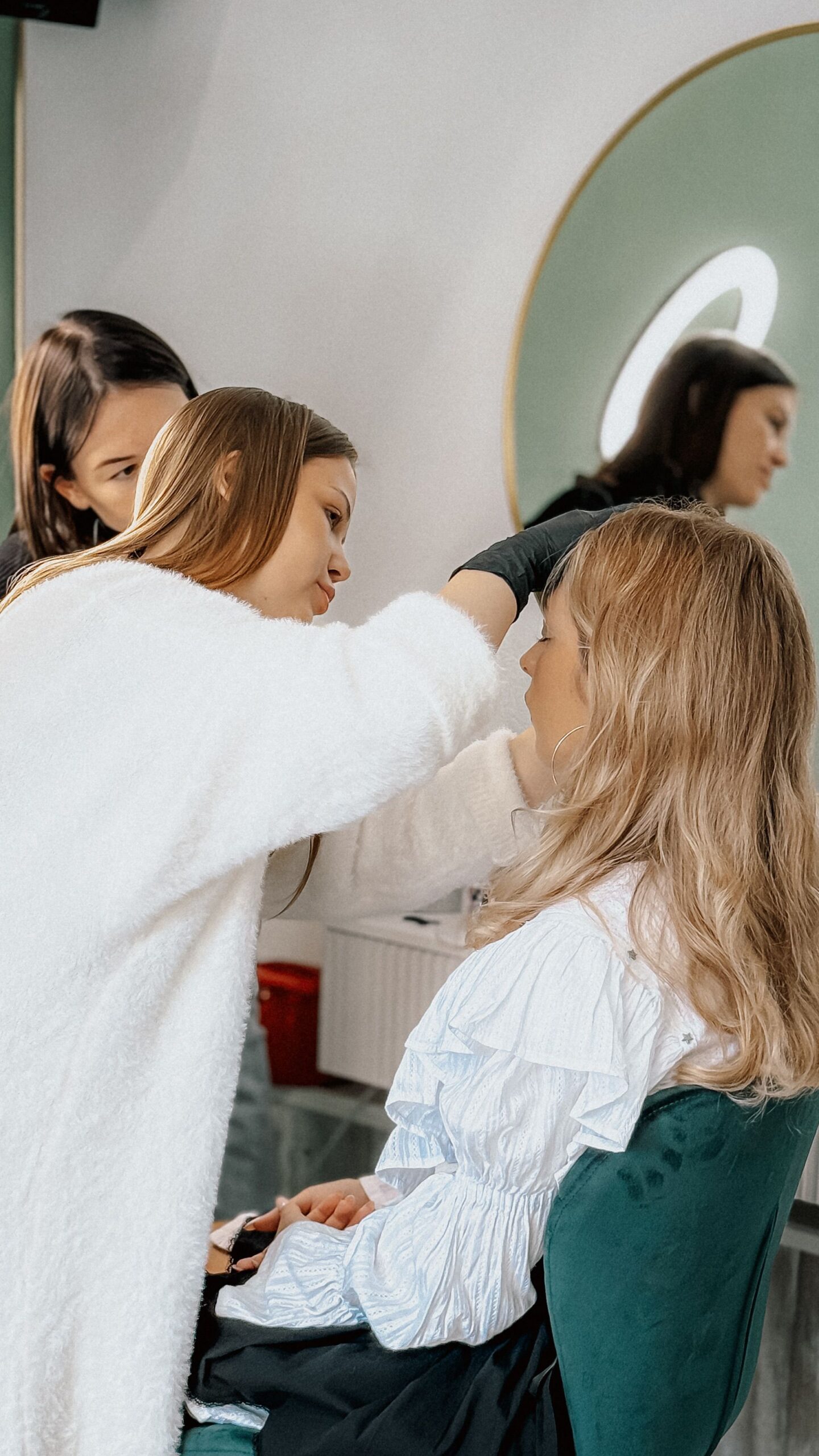
Hair Extension Techniques
Modern hair extension techniques differ in attachment method, procedure duration, correction schedules and care recommendations. They are broadly divided into hot and cold: the first uses heat to create bonds, while the second fixes strands without heating.
Hot Capsule Hair Extensions
Hot capsule extensions involve securing donor strands using small keratin or resin capsules. Under the heat of thermal clamps the material softens, after which the stylist creates a neat bond between the natural and extended hair.
Thanks to point attachment, strands can be evenly distributed across the head, adding overall length or correcting volume in specific areas. The number of strands and duration of the procedure depend on the original hair density and desired result.
Advantages of Hot Extensions
- Extensions can be worn for up to 3–4 months, after which a correction is needed.
- Small capsules remain barely visible in the hair; the stylist determines suitability for fine strands individually.
- This method allows extensions of any texture — from fine Slavic to silky Asian hair.
- Hair can be extended precisely where needed, for example at the temples, fringe or nape.
- Strands comb easily and require no special care instructions.
Features and Limitations of Hot Extensions
- During the procedure bonds are formed using thermal clamps, so the technique must be performed with careful temperature control.
- Capsule-attached strands create additional weight, which can sometimes lead to thinning of growing hair.
- This method is not suitable for those with oily scalps, as capsules break down faster due to active sebaceous gland activity.
- Capsules should be protected from high temperatures and sea water.
An alternative is cold hair extensions, including capsule extensions performed without heat treatment. This is considered more delicate as it minimises the risk of damage to natural hair.
When choosing between hot and cold techniques, consider your hair type and condition to achieve the best result.
Cold Hair Extensions: Features and Types
Cold extensions are performed without thermal clamps or direct heat applied to natural hair. Donor strands can be attached using tapes, special adhesive, rings, beads, wefts or ultrasonic capsules — depending on the chosen method.
This option is often considered by those with fine, weakened or heat-sensitive hair. The attachment method, correction frequency and permitted styling options should be selected individually.
Hollywood Hair Extensions
Hollywood hair extensions is a technique originally used in the film industry, created in Hollywood to give actresses long and beautiful hair for filming.
Previously donor strands were attached using adhesive tape, but this method had drawbacks. The technology was improved and now strands are attached to thin braids in the hair at the back of the head using wefts made from natural threads or keratin capsules fixed with ultrasound.
Limitations:
- Natural hair must be at least 20 cm long.
- Not suitable for very thin hair.
- Some styling options are limited.
The procedure takes 2–3 hours. Extensions last up to 6–8 months, but correction is needed every 1.5–2 months.
Tape Hair Extensions
Tape hair extensions are one of the most popular methods, recommended by salons to those who love wearing long hair. This technology is considered the safest as the hair is not exposed to high temperatures or chemicals during the procedure. It is even suitable for pregnant and breastfeeding women.
Strands are attached using adhesive tapes 4–6 cm wide, adding volume and extending hair by up to 60 cm. With proper care and regular correction, extensions can last up to 10–12 months.
Tape extension techniques:
- Hair Talk (German method) — 4 cm wide strands, suitable for short and fine hair. Correction after 9 weeks.
- Angelo Hair (Italian method) — lightweight 3 cm wide tapes made from Slavic hair. Correction after 7–10 weeks.
- Micro tapes — the narrowest tapes, 0.5–1.5 cm wide, for the finest hair. Correction after 4–5 weeks.
Disadvantages:
- Restrictions on certain hairstyles.
- Need for frequent correction every 2–3 months.
- Inability to colour regrown roots.
Spanish Hair Extensions
Spanish hair extensions is a cold technique in which donor strands are attached to natural hair without high temperature. A special adhesive compound is used for bonding, which after drying forms small, strong capsules.
The stylist separates thin natural strands and manually attaches donor locks to them. The adhesive capsule forms without heat, so hair is not exposed to thermal stress.
Attachment points are small and neat, and extended strands can be styled, curled and coloured. This technique works best on light and blonde hair, as the capsules may take on a light shade after drying.
Who is the Spanish technique suitable for:
- Natural hair must be long enough to conceal the capsules and ensure a natural look.
- The method suits hair of medium density that can support the additional weight of donor strands.
- Attachment points are least visible on light and blonde hair.
The procedure takes several hours depending on the number of strands and desired result. Correction is usually needed after 2–3 months.
Spanish hair extensions suit those who want to add length and volume without hot tools.
Advantages of Cold Hair Extensions
- Natural strands are not exposed to thermal stress.
- New locks look so natural they are indistinguishable from your own hair.
- Extended hair can be styled, curled, waved and even coloured.
- No restrictions on cosmetic or care products.
- Locks are not affected by high temperatures, salt water or other environmental factors.
Although cold hair extensions have many advantages, it should be noted that the procedure requires more frequent corrections — approximately every 2 months.
There are 3 attachment options: chemical (Hollywood method), adhesive (Spanish and tape techniques) and bead attachment (Japanese technology).
How Much Do Hair Extensions Cost at PIED-DE-POULE
We have a clear and transparent price list. The price of hair extensions varies depending on the complexity of the task, the number of strands and their length, additional services, cut and styling. Current hair extension prices in Kyiv can be confirmed with the administrator or when booking a consultation.
Please note that periodic correction will be required. The correction schedule is calculated individually — as a rule, a follow-up visit should be planned within 1–3 months.