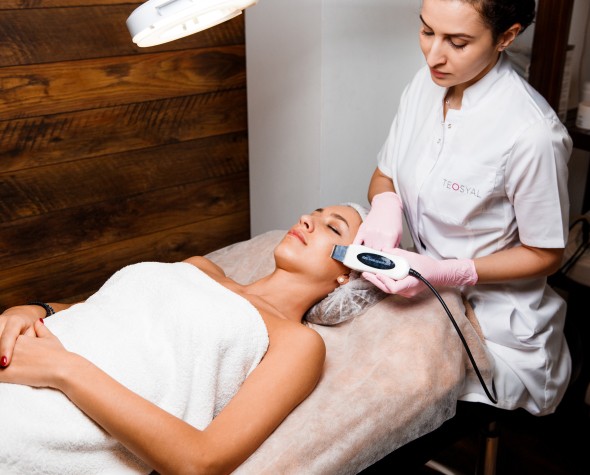
Carboxy therapy is one of the few cosmetic treatments after which you can go straight back to your day. No downtime, no redness, no restrictions. And the results are visible after the very first session: skin looks fresher, firmer, and well-rested.
Dull skin tone, signs of fatigue, dehydration, and loss of natural radiance can appear due to stress, lack of sleep, seasonal changes, or an unsuitable skincare routine. Non-invasive facial carboxytherapy can help improve the appearance of the skin without injections or a lengthy recovery period.
This is a cosmetic procedure in which carbon dioxide, or CO₂, is generated on the skin’s surface through the interaction of a special gel and an active mask. After the session, the skin may look fresher, more hydrated, and more rested, while its tone may appear more even.
The first visible changes may be noticeable after just one procedure. However, the intensity and duration of the result depend on the initial condition of the skin, the home skincare routine, and the number of completed sessions.
What Is Non-Invasive Facial Carboxytherapy?
Two main types of carboxytherapy are used in cosmetology: invasive and non-invasive. Both are based on the use of CO₂, but they differ in how they are performed and how they affect the skin.
During non-invasive carboxytherapy, a cosmetologist applies a special gel to the face and places an active mask over it. The interaction between the components triggers a reaction that releases carbon dioxide. This may be accompanied by a mild sensation of warmth, pressure, or tingling.
The procedure does not involve needles and does not damage the skin’s surface. It therefore usually requires no lengthy recovery and can easily fit into a regular schedule.
How Does Carboxytherapy Affect the Skin?
The carbon dioxide generated during the procedure may promote a local skin response and a temporary improvement in microcirculation.
Non-invasive carboxytherapy may help:
- maintain an optimal level of hydration;
- reduce feelings of dryness and tightness;
- improve the overall appearance of the skin;
- reduce visible signs of fatigue.
Carboxytherapy is a professional skincare procedure. It does not replace treatment for acne, scars, pronounced pigmentation, dermatological conditions, or significant age-related changes. In such cases, consultation with a dermatologist is recommended.
Invasive vs Non-Invasive Carboxytherapy: What Is the Difference?
Both types involve the use of CO₂, but they are performed differently.
| Criterion | Invasive Carboxytherapy | Non-Invasive Carboxytherapy |
| Method | CO₂ is injected under the skin | A special gel and active mask are used |
| Needles | Yes | No |
| Damage to the skin’s surface | Possible at injection sites | Not involved |
| Sensations | Depend on the area and injection method | Mild warmth, pressure, or tingling may occur |
| Recovery | Depends on the protocol and skin response | Usually does not require lengthy recovery |
| Format available at PIED-DE-POULE | Not performed | Performed |
PIED-DE-POULE offers non-invasive, needle-free carboxytherapy. This is a gentle procedure without punctures and may be an alternative for clients who are not ready for injectable treatments.

How Is Non-Invasive Carboxytherapy Performed?
A session takes approximately 40–50 minutes on average. The exact duration depends on the professional protocol, the condition of the skin, and any additional skincare steps.
1. Cleansing and Skin Preparation
The cosmetologist removes makeup, sebum, and surface impurities. This prepares the face for the even application of professional products.
Before starting the session, the specialist also assesses the skin, asks about the home skincare routine, and checks for possible contraindications.
2. Applying the Gel and Active Mask
A special gel is applied to cleansed skin, after which the cosmetologist places an active mask over it. The interaction between the components begins a reaction that releases CO₂.
During this stage, the client may feel mild warmth, tingling, or pressure from the mask. The intensity of these sensations depends on individual skin sensitivity.
3. Finishing Skincare
Once the exposure time is complete, the cosmetologist removes the mask and any remaining product, tones the skin, and applies a serum, cream, or another finishing product selected according to the skin’s needs.
Immediately after the procedure, the face may look fresher, more hydrated, and more rested.
What Results Can Facial Carboxytherapy Provide?
The first visible changes may be noticeable after one session. Improved hydration can make fine dehydration lines appear less pronounced and pores look less visible.
After the procedure, you may notice:
- a fresher and more rested-looking complexion;
- natural skin radiance;
- a visually more even skin tone;
- improved hydration;
- reduced feelings of tightness;
- a firmer and more cared-for appearance;
- less visible signs of fatigue;
- reduced morning puffiness.
The result after the first procedure is mainly visual and skincare-related. For a more lasting effect, the cosmetologist may recommend a course of several sessions.
It is important to remember that every skin response is individual. Carboxytherapy cannot guarantee the same result for everyone and does not remove deep wrinkles, scars, or pronounced pigmentation after a single visit.
Who Is Carboxytherapy Suitable For?
Non-invasive carboxytherapy may be recommended for both younger and mature skin. Whether the procedure is suitable depends primarily on the current condition of the skin, individual sensitivity, and the desired result.
The procedure may be worth considering if you notice:
- a dull or uneven complexion;
- visible signs of fatigue;
- dehydration and tightness;
- reduced skin tone and firmness;
- morning puffiness;
- dryness and lack of natural radiance;
- fine lines associated with dehydration;
- the need to refresh your appearance before an important event.
Carboxytherapy can be part of a regular professional skincare routine or a one-off procedure when the goal is to give the face a fresher and more rested appearance.
If your skin is sensitive or you are having the procedure for the first time, schedule the session well in advance of an important event. Temporary redness, warmth, or increased sensitivity may occur in some cases.
Not sure whether carboxytherapy is suitable for your skin? A PIED-DE-POULE cosmetologist will assess its condition, check for possible contraindications, and help select the most appropriate treatment plan.

Contraindications to Carboxytherapy
Although the procedure does not involve injections or damage to the skin’s surface, it still has certain limitations.
Carboxytherapy is usually not performed in the following cases:
- pregnancy and breastfeeding;
- open wounds, burns, or other damage in the treatment area;
- active inflammatory lesions;
- acute dermatitis or skin conditions during a flare-up;
- individual sensitivity or allergy to product ingredients;
- a recent medium-depth or deep chemical peel;
- acute infectious illnesses;
- severe chronic conditions during an exacerbation.
Be sure to tell the cosmetologist about any dermatological treatment, recent injectable, laser, or device-based procedures, peels, and new cosmetic products that may have caused irritation.
You should also inform the specialist about recent eyelash extensions or lash lamination if professional products will be applied around the eye area.
If you have chronic skin conditions, increased sensitivity, or a tendency toward allergic reactions, it is advisable to consult a doctor before the procedure.
One Procedure or a Course of Carboxytherapy: Which Should You Choose?
Carboxytherapy may be performed as a one-off treatment to improve the appearance of the skin or as a course for a more lasting result.
One session may be suitable if you want to:
- refresh the appearance of the face;
- reduce visible signs of fatigue;
- improve hydration;
- prepare the skin for an important event;
- try the procedure for the first time and assess the skin’s response.
A course may be recommended if the skin regularly looks dehydrated, dull, or tired. The exact number of procedures and their frequency are determined by the cosmetologist based on the condition of the skin, the desired result, and the professional protocol.
Do not increase the frequency of sessions on your own. Overly intensive skincare does not always improve the result and may lead to increased skin sensitivity.
How to Prepare for Carboxytherapy
Complex preparation is usually not required before non-invasive carboxytherapy.
Before your visit, it is advisable to:
- avoid using new aggressive cosmetic products;
- temporarily stop using scrubs and other potentially irritating products;
- tell the cosmetologist if you use acids or retinoids;
- mention any recent peels, injectable, laser, or device-based procedures;
- report any allergies or increased skin sensitivity;
- avoid applying heavy makeup before the appointment if possible.
If inflammation, irritation, skin damage, or signs of an allergic reaction appear before the appointment, contact the salon in advance to check whether the procedure should go ahead.
How to Care for the Skin After the Procedure
After non-invasive carboxytherapy, you can usually return to your normal routine. During the first 24 hours, however, it is advisable to keep skincare gentle.
After the procedure, it is recommended to:
- use mild cleansing products;
- apply a moisturising cream;
- use sunscreen with an appropriate SPF;
- avoid rubbing the skin or using harsh cleansing brushes;
- temporarily stop using scrubs;
- avoid acids, retinoids, and other potentially irritating ingredients;
- follow the cosmetologist’s individual recommendations.
Whether makeup can be applied depends on the condition of the skin and the protocol used. If redness or increased sensitivity occurs, it is better to let the skin rest and postpone decorative cosmetics.
Can Carboxytherapy Be Performed in Summer?
Non-invasive carboxytherapy is generally not considered a procedure with strict seasonal restrictions because it does not involve controlled skin damage or intensive exfoliation.
However, daily sunscreen use is especially important in summer, particularly if carboxytherapy is combined with peels, facial cleansing, or other cosmetic procedures.
If the skin is irritated after prolonged sun exposure or shows signs of sunburn, the procedure should be postponed until the skin has fully recovered.
Carboxytherapy or a Peel: What Is the Difference?
Carboxytherapy and facial peels can both improve the appearance of the skin, but they work in different ways and are not interchangeable.
| Criterion | Carboxytherapy | Facial Peel |
| Main effect | Skincare, hydration, and improvement of overall skin appearance | Exfoliation of dead skin cells |
| Skin damage | Usually not involved | Depends on the type and depth of the peel |
| Recovery | Usually not required | May be required depending on the procedure |
| When it is chosen | Dullness, dehydration, signs of fatigue | Uneven texture, excessive keratinisation, certain types of pigmentation |
| Seasonal restrictions | Usually no strict seasonal restrictions | Depend on the type, formula, and depth of action |
The cosmetologist selects the most appropriate procedure after assessing the condition of the skin. In some cases, carboxytherapy and a peel may be included in the same comprehensive skincare programme.
Which Procedures Can Be Combined With Carboxytherapy?
Carboxytherapy may be included in a comprehensive professional skincare programme. It may be combined with:
- facial cleansing;
- manual facial cleansing;
- ultrasonic facial cleansing;
- facial peels;
- mesotherapy;
- professional hydrating and restorative treatments.
There is no universal sequence. Whether procedures can be combined, in what order, and at what interval depends on their intensity, the condition of the skin, and the individual response.
For example, after a peel or facial cleansing, the cosmetologist may recommend waiting for a certain period to allow the skin to recover. It is not advisable to schedule several intensive procedures within a short period without professional guidance.
Non-Invasive Carboxytherapy at PIED-DE-POULE
PIED-DE-POULE salons offer non-invasive carboxytherapy without needles or damage to the skin’s surface. Before the session, the cosmetologist assesses the current condition of the skin, asks about the home skincare routine, checks for possible contraindications, and helps determine the most appropriate treatment format.
Depending on the skin’s needs, the specialist may recommend:
- one procedure to improve the appearance of the skin;
- a course of several sessions;
- maintenance professional skincare;
- combining carboxytherapy with other procedures.
A personalised approach helps avoid excessive stress on the skin and supports realistic expectations regarding the result.
Learn more about non-invasive carboxytherapy or book your procedure online at a convenient time. The cosmetologist will select a treatment plan based on the needs and condition of your skin.any salon in the network in Kyiv, Kharkiv, Odesa, Bucha, and other cities.